What are the most common causes of forklift tipping? The answer often begins with a familiar scene: a loaded truck turns too quickly, crosses uneven flooring, or carries its forks too high. Each choice can shift the truck’s center of gravity beyond its stability triangle. A heavy load does not need to fall far to make a forklift dangerously unstable.
OSHA reports that forklift-related incidents cause about 85 deaths and 34,900 serious injuries each year in the United States. NIOSH identifies overturns as a major source of forklift fatalities. These figures show why tipping deserves attention, though they do not explain every incident. Site conditions, operator decisions, truck design, and maintenance can combine in ways that are easy to miss.
Forklift safety specialist Raymond G. C. says, “Slow down before the turn.” That advice captures a key risk, but it is not the whole story: speed, load height, uneven surfaces, and poor visibility may interact. A slight slope or a sudden brake can matter. This introduction examines the most common causes of forklift tipping and the practical warning signs workers can spot before a truck begins to lean.
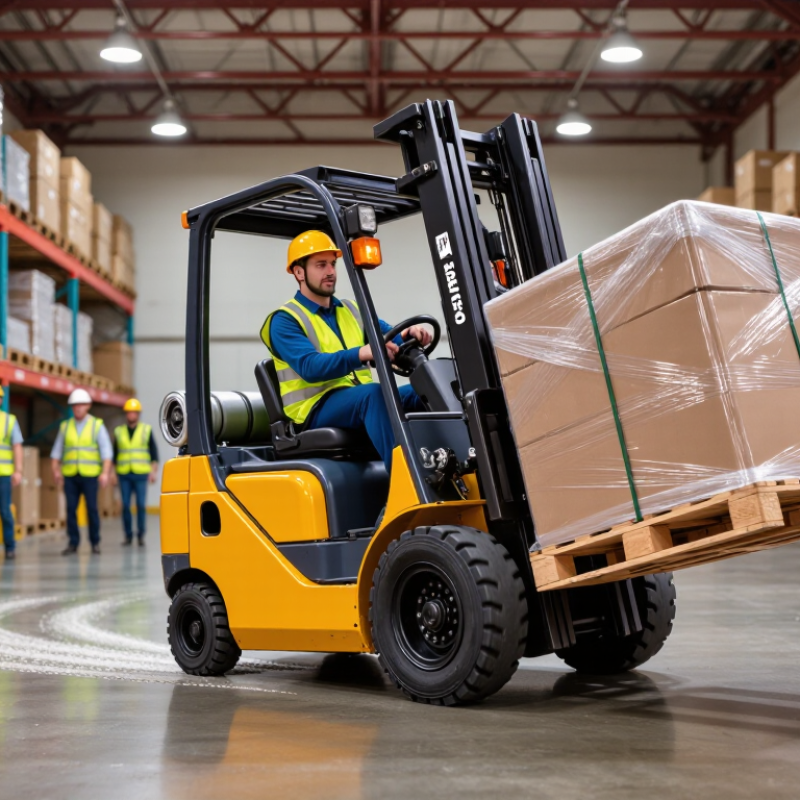
A forklift stays upright when its combined center of gravity remains inside the truck’s stability triangle. That triangle is formed by the front wheels and rear axle pivot. When a load is raised, the combined center of gravity moves upward and forward. The higher it rises, the less room the truck has to absorb movement. Small shifts count.
Load weight is only part of the picture. A long load moves its center farther from the front wheels, adding leverage. Turning sharply, braking hard, or crossing a pothole can shift the combined center of gravity sideways. A side slope makes that shift more risky. Even a familiar route can feel different when the surface is wet, uneven, or sloped.
Keep the load low while traveling, and turn slowly. Follow the operating guidance for mast tilt. These habits reduce risk, but they do not make an unstable load safe. Overloading can cause a forward tip; turning or uneven ground can contribute to a sideways tip. Check the capacity plate and account for load dimensions, not just weight. A rule of thumb helps, but it is not a guarantee. Operators can misjudge how quickly a raised load changes balance. That part deserves attention.
A forklift tips when its combined center of gravity leaves the stability triangle. That triangle uses the front wheels and rear axle pivot. Raised loads move the center upward and forward. Small movements can matter.
A raised load gives the forklift less room to absorb movement. The higher the load rises, the greater the tipping risk. Keep loads low while traveling. High loads need extra care.
Yes. A long load shifts its center farther from the front wheels. That added leverage can destabilize the forklift. Weight alone does not show the full risk. Dimensions matter too.
Sharp turns, sudden braking, and fast acceleration can shift the load. Speed makes corrections harder in narrow aisles. Slow before turning. Keep the load low.
Potholes, broken edges, debris, and dock plates can shift the forklift suddenly. A route may look level until one wheel crosses a damaged joint. Wet or uneven surfaces deserve slower travel. Small correction, big difference.
Follow the operating guidance for the forklift and load. Avoid turning across a slope. Travel in the recommended direction for the load. A familiar route can still feel different.
Overloading can move the combined center of gravity beyond the stability triangle. It may cause a forward tip, especially with a raised load. Check the capacity plate before lifting. A rule of thumb is not a guarantee.
Check the load’s weight, dimensions, position, and stability. Make sure it is centered and stacked securely. Do not move a loose or off-center load casually. Inevitably, rushed checks get missed.
Do not guess through an aisle with limited visibility. Use a clear route and request assistance when necessary. Keep the travel path visible. Pause before moving.
Remain seated and use the provided restraint. Do not jump from the forklift. Keep the body inside the operator area. Training helps, but habits can slip.
What are the most common causes of forklift tipping? A forklift can tip when its center of gravity moves beyond the vehicle’s stability zone. This may happen when a load is too heavy, poorly positioned, unevenly distributed, or raised too high while the truck is moving. Sudden turns, abrupt braking, speeding, and driving with elevated forks can also shift the forklift’s balance and increase the risk of a tip-over.
Workplace conditions play an important role too. Sloped, uneven, slippery, or damaged surfaces, along with obstacles and tight spaces, can make a forklift less stable. Regular inspections and maintenance help identify problems with tires, brakes, forks, and other key components before they affect safe operation. Operators can reduce tipping risks by following load limits, keeping loads low while traveling, adjusting speed to conditions, and using safe driving practices. Together, good equipment care, awareness of the work area, and careful operation support forklift stability.

 Plautz Excavator